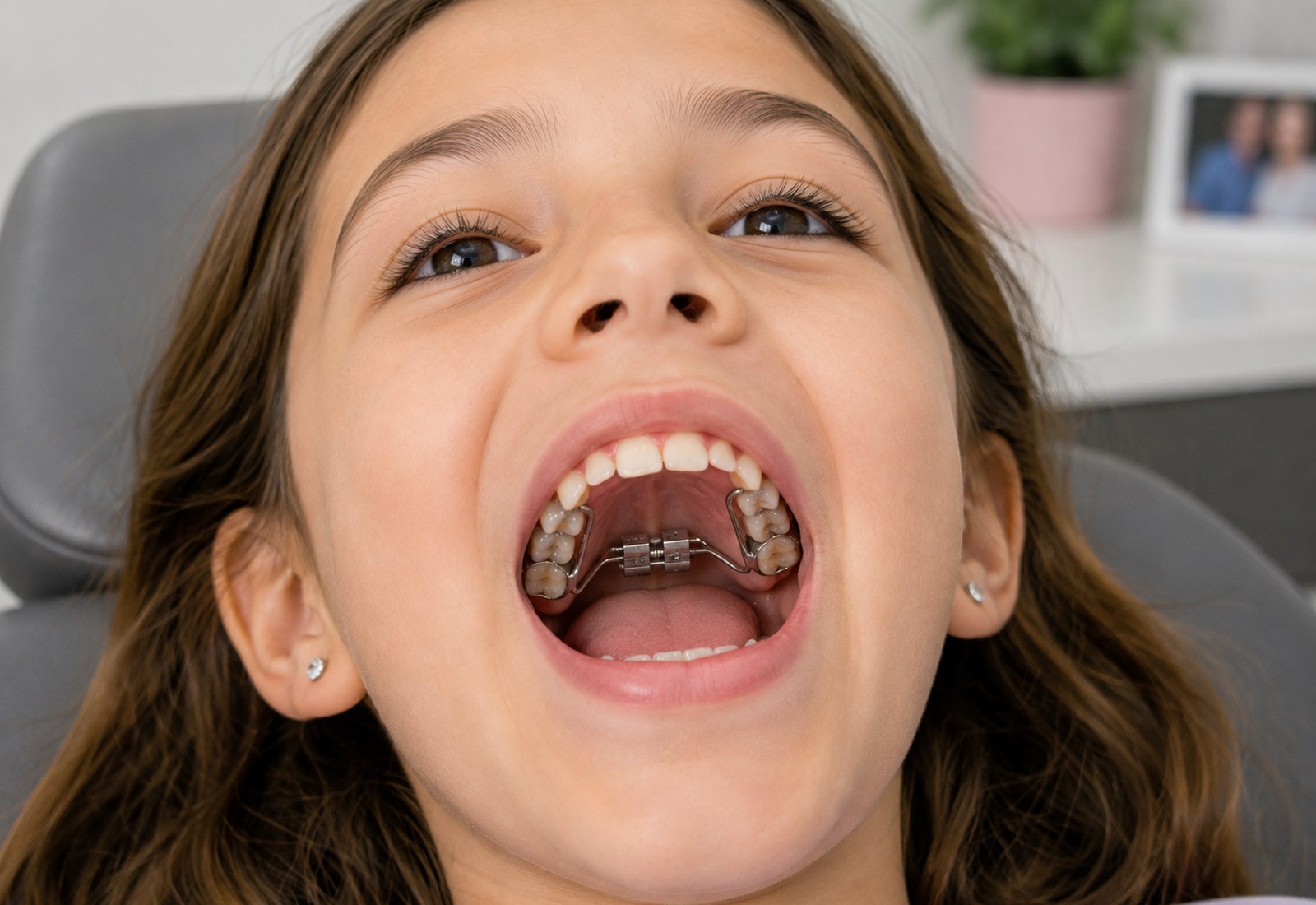
Early treatment, also called Phase 1 or interceptive treatment, is orthodontic care done while a child still has a mix of baby and adult teeth, typically between ages 7 and 10. Its purpose is not to straighten teeth for good. It is to fix a specific developing problem while the jaws are growing and the problem is small.
When early treatment is well supported
- Posterior crossbite with a jaw shift. If the lower jaw slides sideways to let the teeth fit, the jaw can grow asymmetrically. Widening the upper jaw with an expander removes the shift. This is the clearest case for early treatment.
- Anterior crossbite or underbite. Guiding upper jaw growth forward works while the growth plates in the face are still active. In an adult the same problem may need jaw surgery.
- Protruding upper front teeth in an active child. Children with a large overjet are roughly twice as likely to fracture a front tooth. Reducing the overjet early reduces that risk, even though final alignment waits.
- Habits that are deforming the bite. Thumb sucking or soother use past about age 3 to 4 that has created an open bite or narrow arch. A habit appliance plus coaching usually resolves it.
- Impacted or ectopic teeth. Adult canines heading the wrong way can sometimes be redirected by removing a baby tooth or creating space at the right moment.
- Crowding with a narrow arch. Expansion during growth creates room for the adult teeth and is the clinic's preferred route to avoiding extractions later. It also widens the nasal floor, which matters for children who mouth breathe.
When waiting is just as good
Mild crowding, spacing, and overbites without an injury risk in a child whose jaws are growing in proportion. For these children one course of treatment at 11 to 13 gives the same result in fewer years of appliances. The trade-off is explained at the evaluation. Where the jaws are narrow or out of proportion, the calculation changes: guiding growth early is often what makes a non-extraction, non-surgical result possible later, and that is the foundation-first philosophy the clinic follows.
Appliances used in Phase 1
- Palatal expander. Fixed to the upper molars, turned with a small key at home for a few weeks, then left in place for several months while new bone fills in. Mild pressure across the nose for the first days; a temporary gap between the front teeth is normal and closes.
- Partial braces. Brackets on the front teeth only, to align them or correct a crossbite, for about 9 to 12 months.
- Functional appliances. Removable or fixed appliances that hold the lower jaw forward to encourage growth in underbite or deep overbite cases.
- Habit appliances. A small fixed reminder behind the upper front teeth that makes thumb sucking unsatisfying.
- Invisalign First. Aligners designed for mixed dentition, used for expansion and alignment in selected children who will wear them reliably.
- Space maintainers. Holding room when a baby tooth is lost early.
What Phase 1 does not do
It does not usually produce a finished result. After Phase 1 there is a rest period of a year or more while the remaining adult teeth come in, followed in most cases by a shorter Phase 2 with braces or aligners. Parents should expect two phases when they sign up for the first, and should ask whether the Phase 1 fee is credited toward Phase 2. See two-phase treatment.
Cost and duration
Phase 1 typically lasts 9 to 15 months of active treatment plus retention. Fees are a fraction of comprehensive treatment and depend on the appliance. Insurance plans with orthodontic coverage generally apply to Phase 1, but it draws on the same lifetime maximum as Phase 2. See cost and insurance.
Common questions
What age is Phase 1 treatment?
Usually between 7 and 10, while the child has a mix of baby and adult teeth and the jaws are still growing.
How long does an expander stay in?
Turning takes a few weeks; the expander then stays in place for several months, typically 6 to 9 in total, while new bone stabilizes the wider jaw.
Does early treatment hurt?
Expanders cause mild pressure across the nose and cheeks for the first days of turning. Partial braces cause the same tenderness as full braces for a few days. Nothing is done at the first visit.
Is Phase 1 covered by insurance?
Plans with orthodontic coverage generally apply to Phase 1, but it draws on the same lifetime maximum as any later treatment.
Ready to find out what your options are?
Complimentary evaluations for children, teens and adults at myORTHODONTIST Maple Ridge on Dewdney Trunk Road. No referral needed.