Orthodontics for kids: a parent's guide
Age 7 is the guideline. Most children need nothing yet. Here is how to tell which category yours is in.
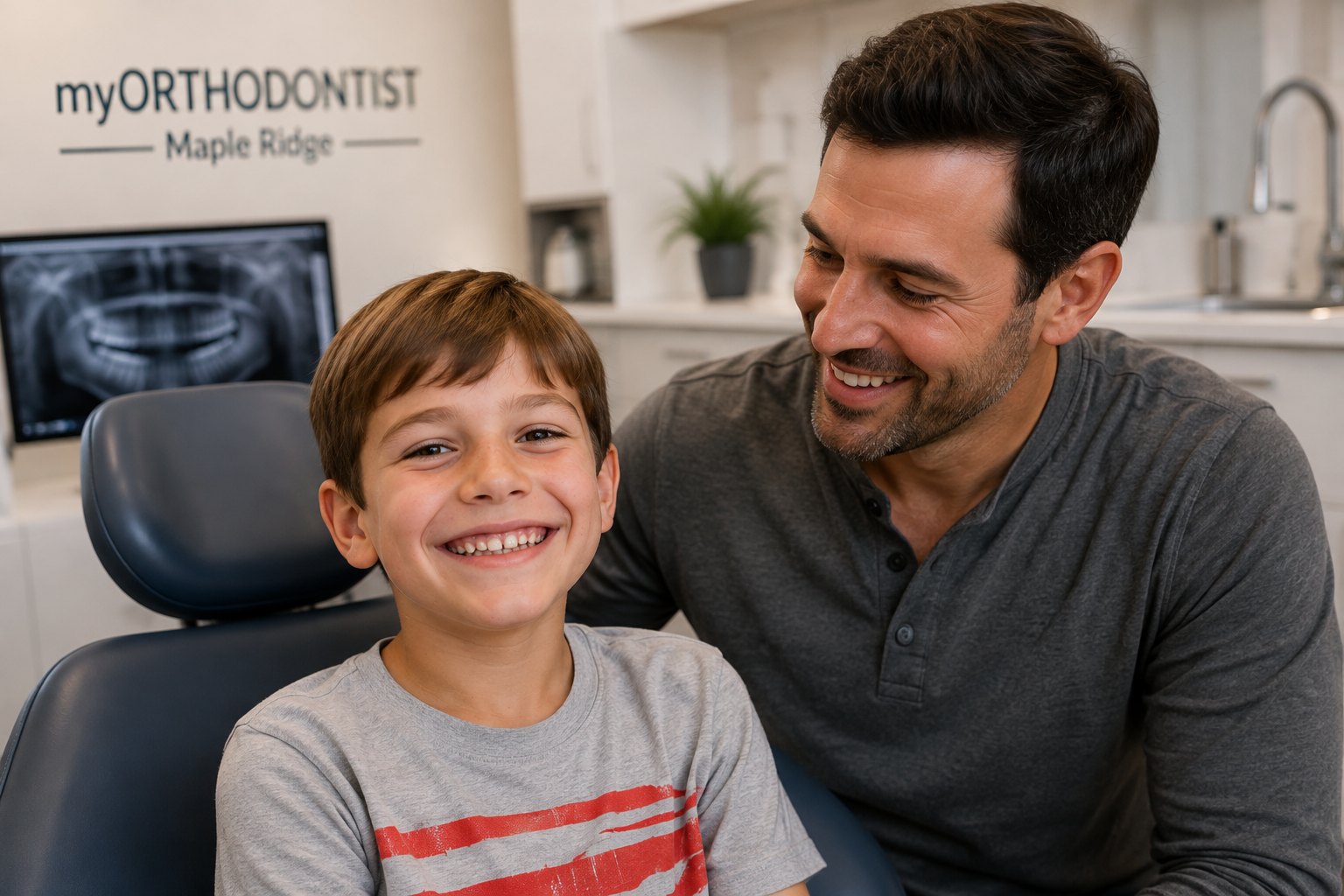
This guide is for parents who have noticed something about their child's teeth, or whose dentist has suggested an orthodontic assessment, and who want to understand the landscape before booking anything. It covers when to go, what an orthodontist looks for in a child, what early treatment is and is not, and how to avoid both over-treatment and missed windows.
When should a child first see an orthodontist?
The Canadian Association of Orthodontists and the American Association of Orthodontists both recommend a first assessment by about age 7. That is not because most 7-year-olds need treatment. It is because by age 7 the first adult molars and front teeth have usually come in, which is enough to see how the bite is developing, and it is the age at which a small number of problems are much easier to correct than they will be later.
Most children assessed at 7 leave with a plan to watch and wait. At myORTHODONTIST Maple Ridge those recall visits, usually every 6 to 12 months, are free. Details on what age should my child first see an orthodontist?
What the orthodontist is looking for
- Crossbites, where upper teeth bite inside the lower teeth on one or both sides. These can shift the lower jaw to one side as the child grows and are the most common reason for early treatment.
- A narrow upper jaw, which often goes with a crossbite, crowding, and mouth breathing.
- Severe crowding or teeth coming in far out of position, which can trap adult teeth or damage neighbouring roots.
- Front teeth that stick out (large overjet), which roughly doubles the risk of a broken front tooth in an active child.
- Underbites, where the lower jaw sits ahead of the upper. Growth modification works best early for these.
- Open bites and habits that cause them: thumb sucking, soother use past age 3, tongue posture.
- Breathing and sleep: mouth breathing, snoring, restless sleep, dark circles, a long narrow face. See airway orthodontics.
- Missing, extra or impacted teeth, visible only on the x-ray.
Three possible outcomes of the first visit
- Everything is developing normally. Recheck in a year. This is the most common outcome.
- Something is developing that will be easier to fix now. This is Phase 1, or early interceptive treatment, usually a 9 to 15 month course with an expander, a habit appliance, partial braces or a functional appliance. Explained on the early treatment page.
- There is a problem, but the right time to treat it is later. Many crowding cases fall here: the orthodontist can see that treatment will be needed around age 11 to 13 when the adult teeth are in, but starting earlier would not change the result.
How to understand a Phase 1 recommendation
Early treatment is one of the most valuable things orthodontics does. It should always come with a reason the orthodontist can name. Questions that help:
- What specifically will get worse if we wait?
- Will Phase 1 mean my child avoids braces later, or just shortens them? (Usually the latter. Honest offices say so.)
- What is the growth reason for treating now? For crossbites, underbites, narrow jaws and protruding front teeth with injury risk, early treatment is well supported. For mild crowding in well-proportioned jaws, waiting is usually just as good.
We are happy to be asked these questions. Our own view is on the page signs your child may benefit from Phase 1.
Comprehensive treatment: ages 11 to 15
Most orthodontic treatment happens once the adult teeth are in, typically between 11 and 15. Options are braces or Invisalign for teens, and the choice depends heavily on the child. Treatment runs 12 to 24 months and finishes with retainers.
Preparing your child
Tell them what will happen: photos, a scan that tickles, an x-ray that circles their head, and a conversation. Nothing hurts at a first visit. Let them ask the orthodontist their own questions; children who understand why they are being treated wear their appliances better. If your child is anxious about dental settings, tell the coordinator when you book so the team can slow things down.
Cost for children
Phase 1 treatment is a fraction of the cost of comprehensive treatment; the comprehensive fee depends on the diagnosis, the appliance and how long treatment takes, and is quoted in writing at the evaluation. Most employer insurance plans with orthodontic coverage cover dependent children, typically 50 percent to a lifetime maximum. If a child has two phases, ask whether the clinic credits the Phase 1 fee toward Phase 2. See cost and insurance.
Common questions
Does every 7-year-old need braces?
No. Most children assessed at 7 are rechecked every 6 to 12 months while their adult teeth come in. Early treatment is recommended when a growth problem is developing, such as a crossbite, underbite, narrow jaw, protruding front teeth or a harmful habit, where guiding growth now sets a better foundation.
Will early treatment mean my child avoids braces later?
Usually not. Phase 1 corrects a specific problem and often makes later treatment shorter or simpler, but most children still need a second phase once the adult teeth are in.
Does my child need a referral from a dentist?
No. Parents in BC can book an orthodontic assessment directly. The clinic will send a report to your dentist.
Is a first orthodontic assessment free?
At myORTHODONTIST Maple Ridge the evaluation is complimentary, and children placed on recall are rechecked at no charge.
Ready to find out what your options are?
Complimentary evaluations for children, teens and adults at myORTHODONTIST Maple Ridge on Dewdney Trunk Road. No referral needed. The full fee is quoted in writing before anything starts, insurance is billed directly, and interest-free monthly plans are available.